

1 b = 0.125 B
Bits to Bytes Converter: b to B Conversion Calculator
To convert bits to bytes (b to B), enter your bit value below and click the Convert button. Your byte result also updates automatically as you type, converting between bits and bytes. This free b to B converter and conversion calculator also works vice versa: use Swap units to convert the other way, or Reset to start over. Also see: Gigabits to Terabytes.
Bit (b)
The smallest unit of digital information, representing a single binary value of 0 or 1.
View the bit data unit pageByte (B)
A byte consists of 8 bits and is the standard unit for measuring digital storage. One byte can represent 256 different values (0-255).
View the byte data unit pageHow to Convert Bits to Bytes
To convert bits to bytes, divide by 8 then adjust for scale. Since 1 byte = 8 bits, this conversion translates bit-based measurements to the byte-based units used for storage capacity.
b measures data in bits—commonly used for memory addressing and low-level data specifications.
B measures data in bytes—the standard unit for file sizes, storage capacity, and what you see in file explorers.
1 b = 0.125 B (using SI decimal standard) — or equivalently, 1 B = 8b.
b to B conversion rate: 1 bit equals 0.125bytes — the standard bit to byte data storage conversion used by this calculator.
Quick Facts: b to B Storage Conversion
- Conversion factor: 1 b = 0.125 B (SI decimal)
- Reverse factor: 1 B = 8 b
- Source unit type: fundamental storage unit
- Target unit type: fundamental storage unit
- Category: data storage converter, digital capacity calculator
Steps to Convert Bit to Byte
- Enter your bit value (b) into the bit to byte converter above.
- The equivalent bytes (B) value updates instantly using the b to B conversion factor; click the Convert button to recalculate it manually.
- Use the swap control to reverse the calculation and convert bytes back into bits.
b to B Conversion Formula
Here's the exact b to B formula in copy-paste-ready form — multiply by 0.125 to go from bits to bytes, or by 8 to reverse it — followed by a quick-reference chart of the same conversion.
// Convert b to B
B = b × 0.125

// Reverse: Convert B to b
b = B × 8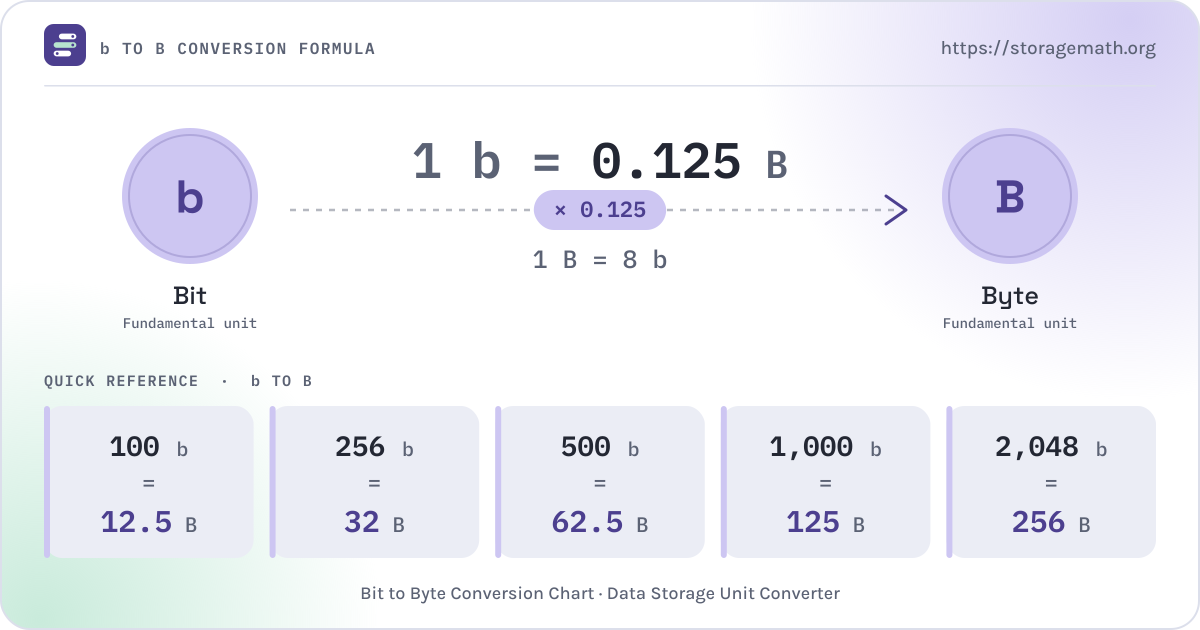
Bit to Byte Conversion Examples
100 b = 12.5 B
256 b = 32 B
500 b = 62.5 B
1,000 b = 125 B
2,048 b = 256 B
What Is a Bit (b)? Definition and Uses
The smallest unit of digital information, representing a single binary value of 0 or 1.
The bit is a fundamental unit of digital information storage. It uses base 1,000 following the SI (International System of Units) standard.
Common uses: Network speeds, data encoding, processor architecture (32-bit, 64-bit)
1 b = 1 bits .
The bit can be abbreviated as b; for example, 1 bit can be written as 1 b.
Bit Storage Unit at a Glance
| Unit type | fundamental |
|---|---|
| Base / standard | Base 1,000 — SI (International System of Units) |
| Symbol | b |
| Common uses | Network speeds, data encoding, processor architecture (32-bit, 64-bit) |
What Is a Byte (B)? Definition and Uses
A byte consists of 8 bits and is the standard unit for measuring digital storage. One byte can represent 256 different values (0-255).
The byte is a fundamental unit of digital information storage. It uses base 1,000 following the SI (International System of Units) standard.
Common uses: File sizes, memory addressing, character encoding (ASCII, UTF-8)
1 B = 8 bits = 1 bytes.
The byte can be abbreviated as B; for example, 1 byte can be written as 1 B.
Byte Storage Unit at a Glance
| Unit type | fundamental |
|---|---|
| Base / standard | Base 1,000 — SI (International System of Units) |
| Symbol | B |
| Common uses | File sizes, memory addressing, character encoding (ASCII, UTF-8) |
Bit to Byte Conversion Table
The table below shows 100 bit measurements converted to bytes — scroll within the table to see the full range.
| Bits | Bytes |
|---|---|
| 1 b | 0.125 B |
| 13 b | 1.625 B |
| 26 b | 3.25 B |
| 39 b | 4.875 B |
| 52 b | 6.5 B |
| 65 b | 8.125 B |
| 78 b | 9.75 B |
| 91 b | 11.375 B |
| 104 b | 13 B |
| 117 b | 14.625 B |
| 130 b | 16.25 B |
| 143 b | 17.875 B |
| 156 b | 19.5 B |
| 169 b | 21.125 B |
| 182 b | 22.75 B |
| 195 b | 24.375 B |
| 208 b | 26 B |
| 221 b | 27.625 B |
| 234 b | 29.25 B |
| 247 b | 30.875 B |
| 260 b | 32.5 B |
| 273 b | 34.125 B |
| 286 b | 35.75 B |
| 299 b | 37.375 B |
| 312 b | 39 B |
| 325 b | 40.625 B |
| 338 b | 42.25 B |
| 351 b | 43.875 B |
| 364 b | 45.5 B |
| 377 b | 47.125 B |
| 390 b | 48.75 B |
| 403 b | 50.375 B |
| 416 b | 52 B |
| 429 b | 53.625 B |
| 442 b | 55.25 B |
| 455 b | 56.875 B |
| 468 b | 58.5 B |
| 481 b | 60.125 B |
| 494 b | 61.75 B |
| 507 b | 63.375 B |
| 520 b | 65 B |
| 533 b | 66.625 B |
| 546 b | 68.25 B |
| 559 b | 69.875 B |
| 572 b | 71.5 B |
| 585 b | 73.125 B |
| 598 b | 74.75 B |
| 611 b | 76.375 B |
| 624 b | 78 B |
| 637 b | 79.625 B |
| 650 b | 81.25 B |
| 663 b | 82.875 B |
| 676 b | 84.5 B |
| 689 b | 86.125 B |
| 702 b | 87.75 B |
| 715 b | 89.375 B |
| 728 b | 91 B |
| 741 b | 92.625 B |
| 754 b | 94.25 B |
| 767 b | 95.875 B |
| 780 b | 97.5 B |
| 793 b | 99.125 B |
| 806 b | 100.75 B |
| 819 b | 102.375 B |
| 832 b | 104 B |
| 845 b | 105.625 B |
| 858 b | 107.25 B |
| 871 b | 108.875 B |
| 884 b | 110.5 B |
| 897 b | 112.125 B |
| 910 b | 113.75 B |
| 923 b | 115.375 B |
| 936 b | 117 B |
| 949 b | 118.625 B |
| 962 b | 120.25 B |
| 975 b | 121.875 B |
| 988 b | 123.5 B |
| 1,001 b | 125.125 B |
| 1,014 b | 126.75 B |
| 1,027 b | 128.375 B |
| 1,040 b | 130 B |
| 1,053 b | 131.625 B |
| 1,066 b | 133.25 B |
| 1,079 b | 134.875 B |
| 1,092 b | 136.5 B |
| 1,105 b | 138.125 B |
| 1,118 b | 139.75 B |
| 1,131 b | 141.375 B |
| 1,144 b | 143 B |
| 1,157 b | 144.625 B |
| 1,170 b | 146.25 B |
| 1,183 b | 147.875 B |
| 1,196 b | 149.5 B |
| 1,209 b | 151.125 B |
| 1,222 b | 152.75 B |
| 1,235 b | 154.375 B |
| 1,248 b | 156 B |
| 1,261 b | 157.625 B |
| 1,274 b | 159.25 B |
| 1,287 b | 160.875 B |
FAQs: Bit to Byte Conversion
5 questions Quick answers on converting bits to bytes, using the same factors as the converter above.
-
How many bytes are in 1 bit?
1 b = 0.125 B
1 Bit (b) equals 0.125 Bytes using the SI decimal standard.
-
How many bits are in 1 byte?
1 B = 8 b
1 Byte (B) equals 8 Bits.
-
How do I convert bits to bytes?
b × 0.125 = B
Multiply the bit value by 0.125 to get bytes. For example, 10 b = 1.25 B. To convert back (vice versa), multiply bytes by 8.
-
Is a bit bigger than a byte?
B is 8× larger than b
No. 1 b = 0.125 B, so the byte is larger — 1 B = 8 b.
-
What is Bit (b) commonly used for?
Common uses of the bit (b) include: Network speeds, data encoding, processor architecture (32-bit, 64-bit).
Need another value? Use the b to B converter or convert B to b.