

1 b = 0.001 Kb
Bits to Kilobits Converter: b to Kb Conversion Calculator
To convert bits to kilobits (b to Kb), enter your bit value below and click the Convert button. Your kilobit result also updates automatically as you type. This free b to Kb converter and conversion calculator also works vice versa: use Swap units to convert the other way, or Reset to start over. Also see: Terabytes to Petabytes.
Bit (b)
The smallest unit of digital information, representing a single binary value of 0 or 1.
View the bit data unit pageKilobit (Kb)
A kilobit is 1,000 bits. Often used for slower network connections and legacy data rates.
View the kilobit data unit pageHow to Convert Bits to Kilobits
To convert bits to kilobits, divide by 1,000. This gives you the equivalent storage size in the target unit.
b: The smallest unit of digital information, representing a single binary value of 0 or 1.
Kb: A kilobit is 1,000 bits. Often used for slower network connections and legacy data rates. Related: Bits to Terabits.
1 b = 0.001 Kb (using SI decimal standard) — or equivalently, 1 Kb = 1,000b.
b to Kb conversion rate: 1 bit equals 0.001kilobits — the standard bit to kilobit data storage conversion used by this calculator.
Quick Facts: b to Kb Storage Conversion
- Conversion factor: 1 b = 0.001 Kb (SI decimal)
- Reverse factor: 1 Kb = 1,000 b
- Source unit type: fundamental storage unit
- Target unit type: SI decimal bit storage unit
- Category: data storage converter, digital capacity calculator
Steps to Convert Bit to Kilobit
- Enter your bit value (b) into the bit to kilobit converter above.
- The equivalent kilobits (Kb) value updates instantly using the b to Kb conversion factor; click the Convert button to recalculate it manually.
- Use the swap control to reverse the calculation and convert kilobits back into bits.
b to Kb Conversion Formula
Here's the exact b to Kb formula in copy-paste-ready form — multiply by 0.001 to go from bits to kilobits, or by 1,000 to reverse it — followed by a quick-reference chart of the same conversion.
// Convert b to Kb
Kb = b × 0.001

// Reverse: Convert Kb to b
b = Kb × 1,000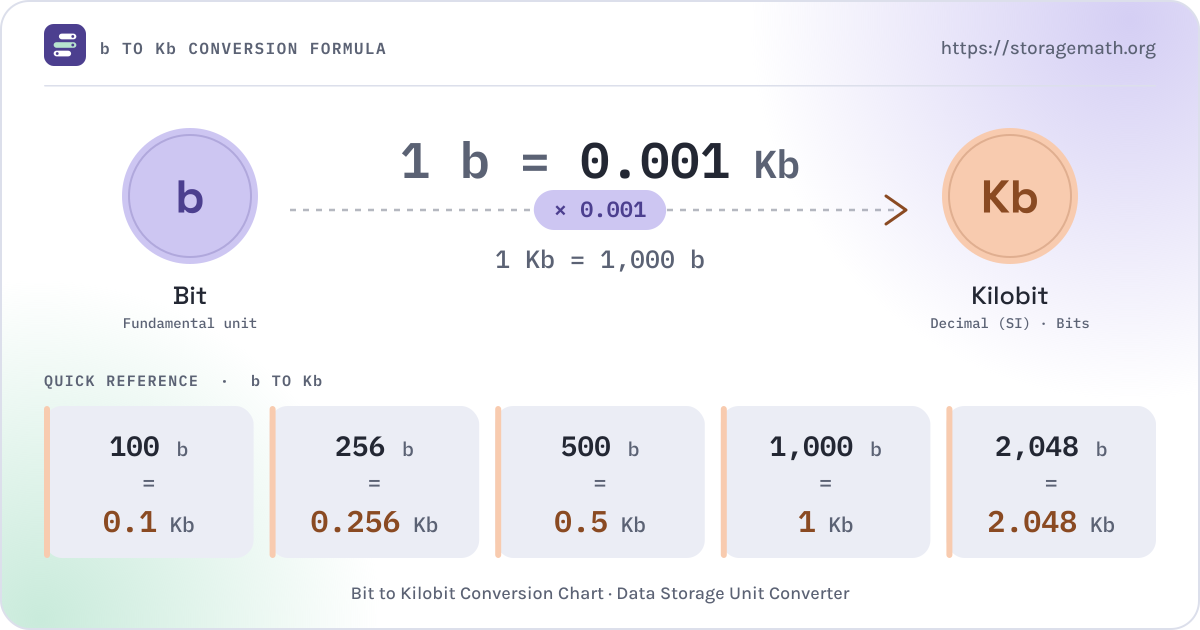
Bit to Kilobit Conversion Examples
100 b = 0.1 Kb
256 b = 0.256 Kb
500 b = 0.5 Kb
1,000 b = 1 Kb
2,048 b = 2.048 Kb
What Is a Bit (b)? Definition and Uses
The smallest unit of digital information, representing a single binary value of 0 or 1.
The bit is a fundamental unit of digital information storage. It uses base 1,000 following the SI (International System of Units) standard.
Common uses: Network speeds, data encoding, processor architecture (32-bit, 64-bit) See also: Bits to Megabits.
1 b = 1 bits .
The bit can be abbreviated as b; for example, 1 bit can be written as 1 b.
Bit Storage Unit at a Glance
| Unit type | fundamental |
|---|---|
| Base / standard | Base 1,000 — SI (International System of Units) |
| Symbol | b |
| Common uses | Network speeds, data encoding, processor architecture (32-bit, 64-bit) |
What Is a Kilobit (Kb)? Definition and Uses
A kilobit is 1,000 bits. Often used for slower network connections and legacy data rates.
The kilobit is a SI decimal bit unit of digital information storage. It uses base 1,000 following the SI (International System of Units) standard.
Common uses: Dial-up modem speeds, low-bandwidth connections, audio bitrates You might also need: Kilobits to Tebibits.
1 Kb = 1,000 bits = 125 bytes.
The kilobit can be abbreviated as Kb; for example, 1 kilobit can be written as 1 Kb.
Kilobit Storage Unit at a Glance
| Unit type | SI decimal bit |
|---|---|
| Base / standard | Base 1,000 — SI (International System of Units) |
| Symbol | Kb |
| Common uses | Dial-up modem speeds, low-bandwidth connections, audio bitrates |
Bit to Kilobit Conversion Table
The table below shows 100 bit measurements converted to kilobits — scroll within the table to see the full range.
| Bits | Kilobits |
|---|---|
| 1 b | 0.001 Kb |
| 13 b | 0.013 Kb |
| 26 b | 0.026 Kb |
| 39 b | 0.039 Kb |
| 52 b | 0.052 Kb |
| 65 b | 0.065 Kb |
| 78 b | 0.078 Kb |
| 91 b | 0.091 Kb |
| 104 b | 0.104 Kb |
| 117 b | 0.117 Kb |
| 130 b | 0.13 Kb |
| 143 b | 0.143 Kb |
| 156 b | 0.156 Kb |
| 169 b | 0.169 Kb |
| 182 b | 0.182 Kb |
| 195 b | 0.195 Kb |
| 208 b | 0.208 Kb |
| 221 b | 0.221 Kb |
| 234 b | 0.234 Kb |
| 247 b | 0.247 Kb |
| 260 b | 0.26 Kb |
| 273 b | 0.273 Kb |
| 286 b | 0.286 Kb |
| 299 b | 0.299 Kb |
| 312 b | 0.312 Kb |
| 325 b | 0.325 Kb |
| 338 b | 0.338 Kb |
| 351 b | 0.351 Kb |
| 364 b | 0.364 Kb |
| 377 b | 0.377 Kb |
| 390 b | 0.39 Kb |
| 403 b | 0.403 Kb |
| 416 b | 0.416 Kb |
| 429 b | 0.429 Kb |
| 442 b | 0.442 Kb |
| 455 b | 0.455 Kb |
| 468 b | 0.468 Kb |
| 481 b | 0.481 Kb |
| 494 b | 0.494 Kb |
| 507 b | 0.507 Kb |
| 520 b | 0.52 Kb |
| 533 b | 0.533 Kb |
| 546 b | 0.546 Kb |
| 559 b | 0.559 Kb |
| 572 b | 0.572 Kb |
| 585 b | 0.585 Kb |
| 598 b | 0.598 Kb |
| 611 b | 0.611 Kb |
| 624 b | 0.624 Kb |
| 637 b | 0.637 Kb |
| 650 b | 0.65 Kb |
| 663 b | 0.663 Kb |
| 676 b | 0.676 Kb |
| 689 b | 0.689 Kb |
| 702 b | 0.702 Kb |
| 715 b | 0.715 Kb |
| 728 b | 0.728 Kb |
| 741 b | 0.741 Kb |
| 754 b | 0.754 Kb |
| 767 b | 0.767 Kb |
| 780 b | 0.78 Kb |
| 793 b | 0.793 Kb |
| 806 b | 0.806 Kb |
| 819 b | 0.819 Kb |
| 832 b | 0.832 Kb |
| 845 b | 0.845 Kb |
| 858 b | 0.858 Kb |
| 871 b | 0.871 Kb |
| 884 b | 0.884 Kb |
| 897 b | 0.897 Kb |
| 910 b | 0.91 Kb |
| 923 b | 0.923 Kb |
| 936 b | 0.936 Kb |
| 949 b | 0.949 Kb |
| 962 b | 0.962 Kb |
| 975 b | 0.975 Kb |
| 988 b | 0.988 Kb |
| 1,001 b | 1.001 Kb |
| 1,014 b | 1.014 Kb |
| 1,027 b | 1.027 Kb |
| 1,040 b | 1.04 Kb |
| 1,053 b | 1.053 Kb |
| 1,066 b | 1.066 Kb |
| 1,079 b | 1.079 Kb |
| 1,092 b | 1.092 Kb |
| 1,105 b | 1.105 Kb |
| 1,118 b | 1.118 Kb |
| 1,131 b | 1.131 Kb |
| 1,144 b | 1.144 Kb |
| 1,157 b | 1.157 Kb |
| 1,170 b | 1.17 Kb |
| 1,183 b | 1.183 Kb |
| 1,196 b | 1.196 Kb |
| 1,209 b | 1.209 Kb |
| 1,222 b | 1.222 Kb |
| 1,235 b | 1.235 Kb |
| 1,248 b | 1.248 Kb |
| 1,261 b | 1.261 Kb |
| 1,274 b | 1.274 Kb |
| 1,287 b | 1.287 Kb |
FAQs: Bit to Kilobit Conversion
5 questions Quick answers on converting bits to kilobits, using the same factors as the converter above.
-
How many kilobits are in 1 bit?
1 b = 0.001 Kb
1 Bit (b) equals 0.001 Kilobits using the SI decimal standard.
-
How many bits are in 1 kilobit?
1 Kb = 1,000 b
1 Kilobit (Kb) equals 1,000 Bits.
-
How do I convert bits to kilobits?
b × 0.001 = Kb
Multiply the bit value by 0.001 to get kilobits. For example, 10 b = 0.01 Kb. To convert back (vice versa), multiply kilobits by 1,000.
-
Is a bit bigger than a kilobit?
Kb is 1,000× larger than b
No. 1 b = 0.001 Kb, so the kilobit is larger — 1 Kb = 1,000 b.
-
What is Bit (b) commonly used for?
Common uses of the bit (b) include: Network speeds, data encoding, processor architecture (32-bit, 64-bit).
Need another value? Use the b to Kb converter or convert Kb to b.